Low Guna Score but Strong Marriage Yog? How to Decide Safely

The Great Astrological Paradox
Imagine this: You have found the absolute perfect partner. You share the same values, the same career ambitions, and possess undeniable chemistry. Your families agree, and everything is set. To make it "official," your parents generate an online Kundli matching report. The screen flashes red. You scored an abysmally low 14 out of 36 points. The text dictates that proceeding with this marriage guarantees misery, poverty, and sorrow.
But when you take that same chart to a deeply experienced, 70-year-old Vedic scholar, he smiles, pushes the printout away, and says, "Ignore the software. You both possess a formidable, unbreakable Marriage Yog in your primary charts. Marry them without fear."
How is this possible? How can a digital matching system predict destruction, while an expert predicts eternal bliss? This is the paradox of the "Low Guna Score vs. Strong Marriage Yog." In this detailed guide, we will explore exactly why this happens, how to identify if your charts contain overriding positive yogas, and how to safely make a decision when the numbers say "No" but the planets say "Yes."
Look Past The Final Score
Use our advanced engine that inherently identifies deep structural cancellations to give you the TRUTH behind a low score.
Check Advanced Cancellations →Understanding the Flaw in "The Score"
To understand the paradox, you must first understand the fundamental limitation of the Ashtakoot (36 Guna) matching system. The Ashtakoot system is calculated entirely and exclusively based on the position of the Moon at the time of birth.
While the Moon is incredibly important (it rules your emotions, reactions, and daily mindset), it is only one out of nine planets. Ashtakoot completely ignores the Sun (your soul and ego), Jupiter (your wisdom and prosperity), Venus (romance and sexuality), Mars (drive and aggression), Saturn (karma and longevity), and the actual houses (Bhavas) of your astrological chart.
Therefore, a score of 12/36 simply means: "On an emotional and reactive level, these two people naturally misunderstand each other." It DOES NOT mean they will divorce. It means their emotional communication will require active work. But if their actual 7th houses (the domain of marriage) are incredibly strong, the marriage itself will possess cosmic concrete foundations.
Identifying the Overriding "Strong Marriage Yog"
When an astrologer overrides a terrible Ashtakoot score, they are usually looking at the core structural strength of the bride and groom's D1 (Rasi) and D9 (Navamsa) charts. Here are the most powerful structural yogas that can completely obliterate a low Guna score.
1. Mutual Jupiter Blessings (The Cosmic Shield)
Jupiter is the ultimate benefic planet. For a marriage to survive severe emotional incompatibility, it requires massive amounts of grace, wisdom, and forgiveness. If the groom's exalted Jupiter casts its aspect directly onto the bride's 7th house, and her strong Jupiter aspects his Ascendant or Moon, a divine shield is created around the marriage.
Even if they argue (due to the low Guna score), Jupiter ensures they never hold grudges, they respect their mutual boundaries, and they always forgive. Jupiter provides the maturity required to navigate a 14/36 score.
2. Synastry of the Ascendants (Lagna Alignment)
While the Moon dictates feelings, the Ascendant (Lagna) dictates the physical body, the general life path, and core personality. If a couple has a low Moon compatibility, but their Ascendants are perfectly aligned (e.g., they are both Earth signs like Taurus and Capricorn, or their Lagna lords are fast friends like Sun and Jupiter), their fundamental life goals and physical pacing will be entirely synchronized. They will build businesses together and raise children with identical values, successfully bypassing the emotional friction of the Moon misalliance.
3. The 7th Lord Exchange (Maha Parivartana Yoga)
This is a rare and incredibly potent connection. Suppose the Bride's 7th Lord is Venus, and it is sitting in the Groom's 1st house. Simultaneously, the Groom's 7th Lord is Mars, and it is sitting in the Bride's 1st house. This creates a "Parivartana" (exchange) of their marital destiny.
They are quite literally fated to be together. Their destinies are inextricably woven. In such a scenario, a 12/36 Ashtakoot score is practically irrelevant. The universe has bound them via their 7th lords, ensuring a relentless mutual attraction and lifelong commitment that defies their emotional incompatibilities.
4. Navamsa (D9) Purity
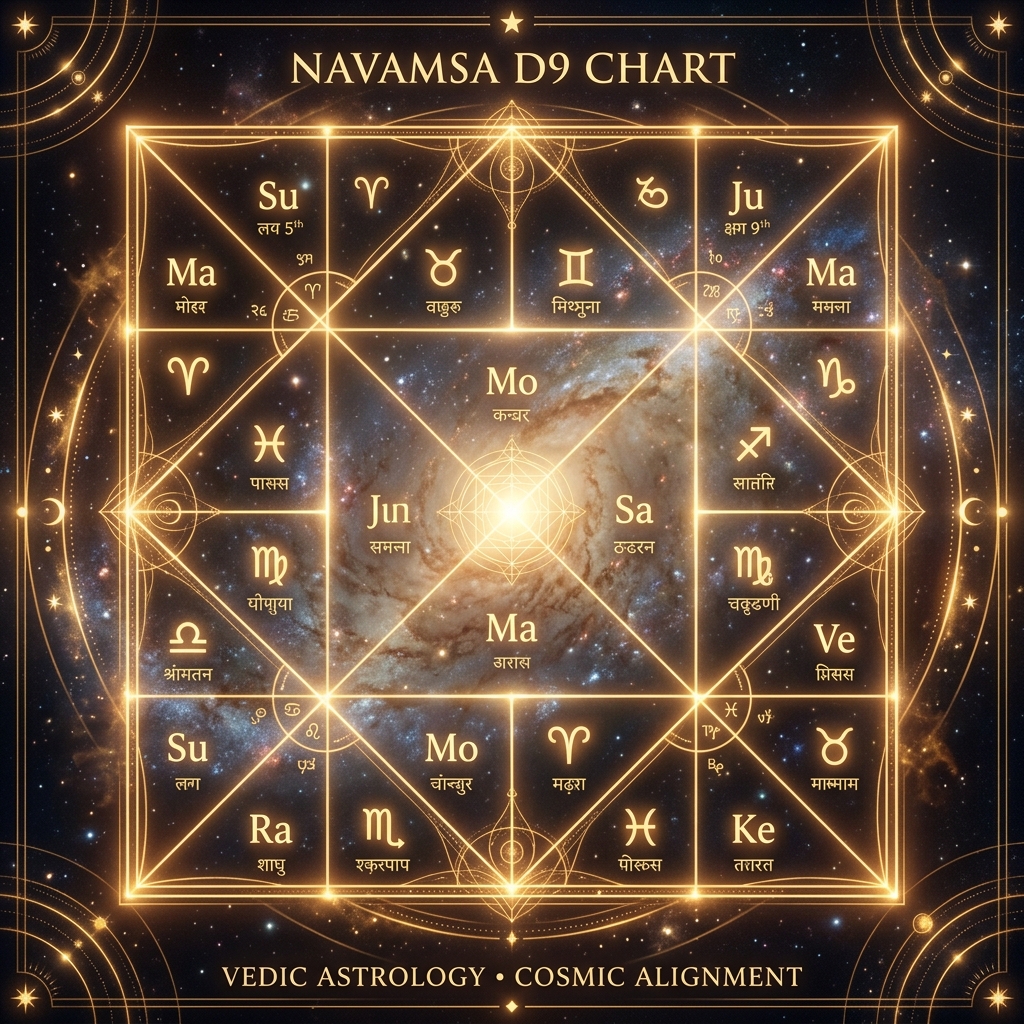
The D1 chart is the facade; the D9 chart is the soul of the marriage. A couple might have a weak Moon matching algorithm in D1, but if you look at their D9 charts and see that both have exalted 7th lords, or an unafflicted Venus sitting in the 9th house of the Navamsa... the marriage will ultimately manifest as an incredibly stable, devoted, and spiritually elevated union. The early years might be rocky, but the D9 dictates that the second half of life will be pure marital bliss.
When to Trust the Low Score (The Red Flags)
We must present a balanced view. While strong yogas CAN override a low score, you should never blindly ignore a low score without proper verification. A low score becomes a lethal prediction when combined with ANY of the following specific chart afflictions:
- Un-cancelled Nadi OR Bhakoot Dosha + Weak 7th House: If you score 0 on Nadi (biological/health crash) AND your 7th house contains Rahu or Saturn... walk away. The chart does not contain enough strength to withstand the health and financial crises predicted by the low score.
- Low Graha Maitri (0 or 1 point) + Afflicted Venus: A lack of mental friendship combined with a weak planet of love means you will not like each other, nor will you find physical/romantic solace in each other. This leads directly to infidelity or highly toxic household environments.
- Dual Manglik Imbalance: If the score is 16, and the groom has an explosive 8th house Mars while the bride is a peace-loving Moon-ruled non-Manglik, her gentle personality will be spiritually crushed. Do not proceed.
The Practical Compromise: The "Work" Marriage
A low Guna score with a strong marriage yog essentially translates to a "Work Marriage." It will not be a fairytale. You will not intuitively read each other's minds. You will have to schedule time to communicate. You will have to go to therapy. You will have to consciously choose to compromise daily. If you love the person enough to treat the marriage like a beautiful, challenging project, the strong Marriage Yog will ensure you succeed spectacularly.
How to Make the Final Decision Safely
If you are trapped between a fearful software report and your genuine love for your partner, follow this safe escalation protocol:
- Step 1: Verify the Math: Use a high-quality modern calculator that automatically checks for Nadi and Bhakoot cancellations. Sometimes a terrifying 12/36 actually jumps to a comfortable 20/36 once the deep mathematical cancellations are executed.
- Step 2: Consult a Master, Not a Novice: Do not use an astrologer who only reads the Ashtakoot table. Present your charts to a seasoned professional and ask them specifically: "Please analyze our Navamsa (D9) charts and the physical strength of our 7th houses. Do we have overriding stability yogas?"
- Step 3: The Introspection Test: Look at your partner. Assume that the low Ashtakoot score is correct and that you will naturally misunderstand each other's emotional reactions 50% of the time. Are you willing to patiently explain yourself to them for the next 40 years without resorting to resentment? If yes, the marriage is safe.
Conclusion: Destiny vs. Data
Data is useful, but the soul is sovereign. The 36-point Guna Milan system was designed thousands of years ago to ensure rapid socio-emotional cohesion in a time when marrying strangers at age 16 was the norm. Today, you are executing adult relationships based on complex psychology and mutual life building.
If your charts confirm a fortified, blessed, and strongly anchored 7th house axis, let the low Guna score act merely as a gentle warning light on your dashboard—reminding you to drive carefully, communicate clearly, and deliberately choose love every single day.