Kundali Matching by Date of Birth and Time: Step-by-Step Guide (2026)
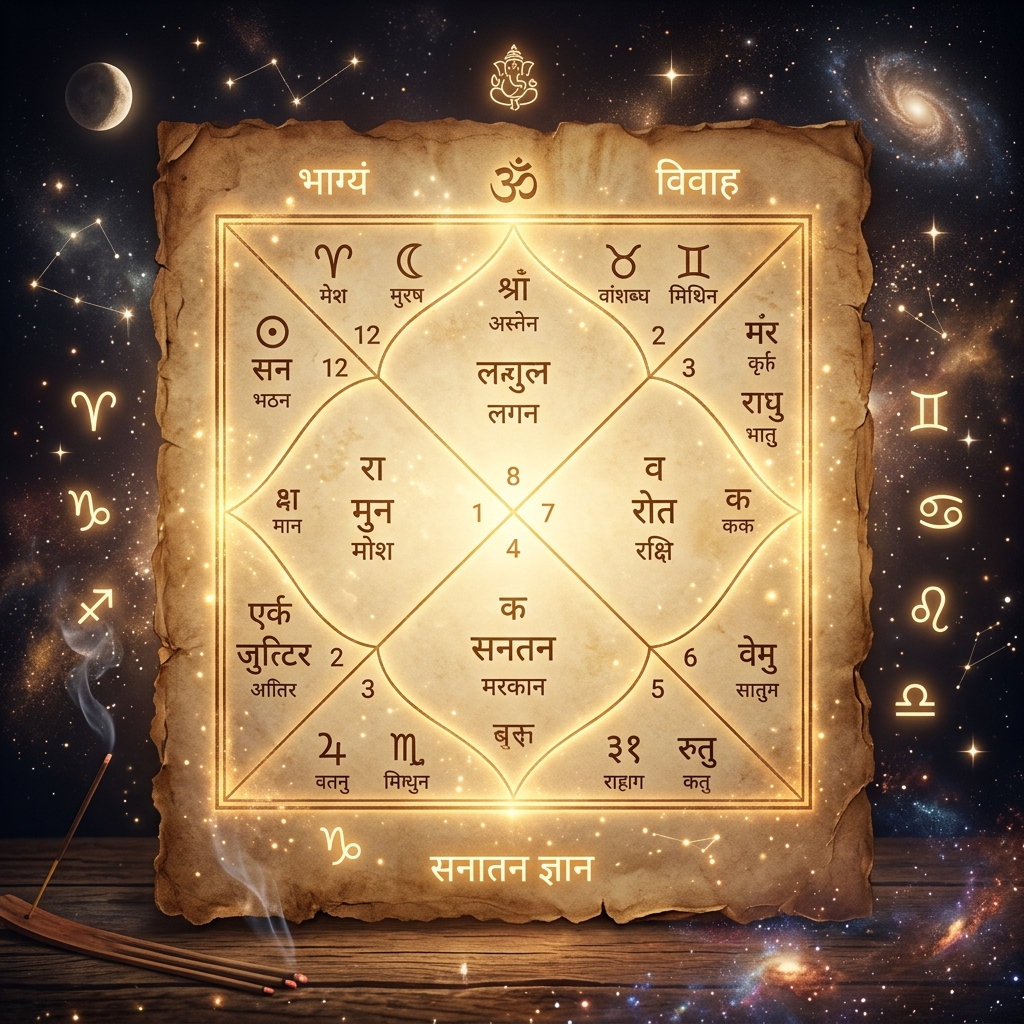
The Definitive Guide to Kundali Matching in 2026
When embarking on the beautiful, lifelong journey of marriage, families across India and the global diaspora consistently turn to a profound and ancient science: Kundali Matching or Guna Milan. This time-tested Vedic astrological framework deeply analyzes the planetary alignments of the prospective bride and groom. But why do we still do it in 2026? Because while human psychology and dating apps focus on your current interests, astrology maps your fundamental energetic blueprint. It predicts your long-term marital harmony, mutual understanding, physical compatibility, and overall prosperity for decades to come.
In this comprehensive, step-by-step guide, we will break down exactly how Kundali matching works using just your Date of Birth, Time of Birth, and Place of Birth. You will learn the mechanics behind the famous "36 point" scoring system (Ashtakoot Milan), understand the red flags you must absolutely avoid, and discover how to read your own compatibility report without relying entirely on a priest or intermediary.
Ready to Check Your Compatibility?
Use our highly accurate, 2026-updated Ashtakoot Milan calculator instantly without manual math.
Run Guna Milan Calculator Free →Step 1: Why Accurate Birth Details Are Non-Negotiable
The entire foundation of any Vedic astrological reading rests on one critical pillar: accuracy. Without precise data, the mathematical calculations governing the planets are flawed, and the resulting compatibility report is useless.
The Triangle of Truth: Date, Time, and Place
While modern dating algorithms use your sun sign (which changes every 30 days), true Vedic compatibility (Guna Milan) uses the exact degree of the Moon at the moment you took your first breath. This requires calculating your Nakshatra (birth star), its Pada (quarter), and your Ascendant (Lagna) sign.
Date of Birth: This gives the overarching position of slow-moving planets like Jupiter and Saturn, which dictate the major themes of your life cycle.
Time of Birth: This is the most critical variable. The Ascendant sign changes every 2 hours, but more importantly for matching, the Moon's Pada (quarter) can change within minutes. If your mother estimates you were born at "around 10:30 AM," you could theoretically belong to an entirely different energy wavelength than someone born at 10:25 AM. Even a 5-minute error can shift a Nakshatra quarter and dramatically change your Nadi or Bhakoot points.
Place of Birth: Astrology is geometry based on earth's rotation. The exact latitude and longitude of your birth hospital define the angles of the houses in your Kundali. A person born at 8:00 AM in New York has a completely different cosmic snapshot than someone born at 8:00 AM on the same day in Mumbai.
Step 2: Generation of the D1 (Rasi) and D9 (Navamsa) Charts
Once you input these details into a software or provide them to an astrologer, two critical charts are generated to gauge your marriage promise.
- D1 Chart (Rasi Chart): This is your physical reality. It shows your basic temperament, career, physical body, and general life path. The 7th house in this chart dictates what kind of spouse you attract.
- D9 Chart (Navamsa Chart): This is arguably the most important chart for marriage. It is the microscopic view of your soul's journey. If the D1 chart is the tree, the D9 chart is the fruit. A marriage may look prosperous in the D1 chart, but if the Navamsa is afflicted, the marriage will ultimately fail. Any professional Kundali matching must cross-reference both partner's D9 charts.
Step 3: The Ashtakoot Framework (The 36 Gunas)
The Ashtakoot system is the mathematical core of Kundali matching. "Ashta" means eight, and "Koota" means aspects. The system evaluates 8 specific parameters based strictly on the Janma Nakshatra (Moon Sign and Star) of the bride and groom. It assigns points to each parameter, culminating in a maximum score of 36 points (Gunas).
Here is a detailed breakdown of what each of the 8 Kootas evaluates and why they matter to your daily marital life:
1. Varna (Work Compatibility & Ego) - 1 Point
This Koota matches the natural energy quotient and the "spiritual grade" of development between the couple. It is divided into four psychic categories (Varnas): Brahmin (Intellectual/Spiritual), Kshatriya (Leader/Warrior), Vaishya (Merchant/Manager), and Shudra (Worker/Service). It ensures that the husband and wife have compatible work ethics and that their egos don't constantly clash over "who works harder."
2. Vashya (Mutual Attraction & Dominance) - 2 Points
Vashya tests the magnetic control and dedication between the partners. Will there be an inherent power struggle? It categorizes signs into types like Chatushpada (four-legged), Dvipada (two-legged/human), Jalchar (water-dwelling), Vanachar (forest-dwelling), and Keeta (insect). A human sign can easily control a four-legged sign, ensuring smooth domestic authority, but a water sign and a forest sign might experience emotional disjoints.
3. Tara (Destiny & Health) - 3 Points
Tara evaluates the auspiciousness of the individual's birth star in relation to their partner's. It relies on a 9-star cycle. If one partner's star falls in a highly inauspicious zone (like the 'Vipat' meaning danger, or 'Vadha' meaning destruction) relative to the other, it indicates that the marriage might bring chronic bad luck, ill health, or professional degradation to one of them.
4. Yoni (Physical & Sexual Compatibility) - 4 Points
This is a critical parameter in modern times. Yoni measures the biological affinity, primal intimacy, and sexual compatibility. It groups nakshatras under 14 animal archetypes (Horse, Elephant, Sheep, Serpent, Dog, Cat, Rat, Cow, Buffalo, Tiger, Hare, Monkey, Lion, Mongoose). If the couple belongs to naturally hostile animals (like Dog and Hare, or Mongoose and Serpent), their physical intimacy will suffer immensely, often leading to infidelity or frigidity.
5. Graha Maitri (Psychological Disposition) - 5 Points
Arguably the most crucial element for sustaining modern marriages where intellectual compatibility is prized. This checks the planetary friendship between the Moon sign lords of both individuals. If the boy's moon is in Aries (ruled by Mars) and the girl's is in Sagittarius (ruled by Jupiter), Mars and Jupiter are friends, securing a 5/5 score. They will communicate beautifully. But if one is ruled by the Sun and the other by Saturn (natural enemies), every conversation will devolve into a bitter argument.
6. Gana (Temperament & Behavior) - 6 Points
Gana divides human temperament into three grand categories: Deva (Divine/Gentle/Righteous), Manushya (Human/Practical/Balanced), and Rakshasa (Demon/Aggressive/Stubborn). A Deva pairing with a Rakshasa is notoriously difficult. The Rakshasa individual will constantly bulldoze the Deva individual's boundaries, leading to severe emotional exhaustion for the Deva and frustration for the Rakshasa.
7. Bhakoot (Family Welfare & Prosperity) - 7 Points
This evaluates the distance between the two Moon signs. This dictates the financial prosperity, growth of legacy, and general harmony of the household. The most feared combination here is the Shadashtak Dosha (6-8 axis). If the bride's sign is 6th from the groom's and the groom's is 8th from the bride's, it indicates severe health and financial ruination unless cancelled by planetary friendship.
8. Nadi (Health, Genetics & Nervous Energy) - 8 Points
Carrying the highest weightage, Nadi is divided into three types: Adi (Vata/Wind), Madhya (Pitta/Bile), and Antya (Kapha/Phlegm). A couple MUST possess different Nadis to marry (scoring 8/8). If they have the same Nadi, they score 0/8, creating a massive Nadi Dosha. Traditionally, this indicates that their genetic makeup is too similar, resulting in disastrous health for their children, frequent miscarriages, or extreme physical weakness in the couple themselves.
Step 4: Interpreting the Total Score (The Guna Milan Verdict)
Once the mathematical calculation is done, you receive a score out of 36. Here is the universally accepted grading system:
- Less than 18 Points (Reject/Caution): The minimum passing threshold is 18. A score below this indicates severe fundamental incompatibilities. While some couples manage via massive psychological effort or powerful cancellation rules (Pariharas), it is generally advised to avoid proceeding unless a master astrologer finds massive D1/D9 mitigating yogas.
- 18 to 24 Points (Average/Acceptable): This is the most common range. The marriage is highly viable but will require conscious effort. Financial and emotional stability will fluctuate normally, but no catastrophic cosmic blocks exist.
- 25 to 32 Points (Excellent): A highly auspicious match. The couple will intuitively understand each other, grow their wealth together, and enjoy a fulfilling romance and healthy children.
- 33 to 36 Points (Rare/Divine - Beware!): While this seems perfect, scores above 33 are incredibly suspicious in practical astrology. Total similarity often means total synchronization of negative planetary dashas. If both have the exact same Nakshatra to achieve this score, they might trigger a Nadi dosha artificially. Proceed with deep analysis.
Step 5: The Crucial 'Mangal Dosha' Validation
Guna Milan is only 50% of Kundali Matching. The other 50% resides in analyzing systemic chart flaws, primarily Mangal Dosha (Kuja Dosha). Mangal Dosha occurs when Mars is placed in the 1st, 2nd, 4th, 7th, 8th, or 12th house of a person's D1 chart.
Mars is the planet of war, ego, explosive anger, and sharp independence. If heavily afflicted, it burns the softness required for a marriage. If one partner is a strong Manglik and the other is a non-Manglik, the non-Manglik partner might suffer psychologically or physically from the sheer force of the other's uncontained Martian energy.
Rules for Manglik Compatibility
If you discover Mangal Dosha during the matching process, follow these rules:
- Check for Cancellations: Over 60% of Manglik charts have an automatic cancellation. If Mars is exalted in Capricorn, or sitting in its own sign of Aries or Scorpio, or receiving a direct benefic aspect from Jupiter, the Dosha is technically nullified.
- Balance the Fire: If it is NOT cancelled, the simplest remedy is to marry another Manglik. The equal fire negates the destruction. Alternatively, marrying someone with a very strong Saturn placement in counter-houses can also absorb the Martian shockwaves.
- Do NOT Ignore It: Do not just look at the 28/36 score and ignore a glaring 8th House Mangal Dosha. The high score will make you great friends, but the unresolved Dosha will ensure those friends fight ruthlessly about money and intimacy.
Myths and Fears Surrounding Nadi Dosha
A score of 18/36 with a 0 in Nadi is vastly different from a score of 18/36 with an 8 in Nadi. Nadi Dosha is notorious for scaring couples into breaking up. However, there are profound exceptions. For instance, if the boy and girl share the exact same Nakshatra BUT belong to different Padas (quarters), the Nadi Dosha is completely cancelled and no ill-effects will transpire regarding childbirth or health. Always verify cancellations before crying over a zero score.
Step 6: Dasha and Transit Synchronization
The final step in a professional matching process is checking the timeline (Dasha). Suppose you have a brilliant 30/36 match. But your chart shows you are currently running a 19-year Saturn Mahadasha that specifically afflicts your 7th house, while your partner is running an exalted Jupiter period.
This creates a timeline fracture. You will be depressed, obsessed with work, and feeling cold towards romance, while your partner will be glowing, expanding, and expecting romantic vacations. This mismatch in actual life phases (Dashas) can destroy even the highest scoring marriages.
Furthermore, an astrologer will use tools like transit analysis to ensure neither of you is undergoing a severe relationship-breaking transit (like a heavy Rahu transit over the 7th house) during the actual first year of marriage.
Conclusion: Modern Application of Vedic Wisdom
Kundali matching by date of birth and time is not about superstition; it is the ultimate psychological profiling tool developed millennia before modern therapy. It does not dictate your destiny, but it maps the exact terrain of your marital road. If the report says the road is smooth (30/36), you can drive fast. If the report says the road is full of potholes (15/36 with Mangal Dosha), it simply means you need better suspension, extreme patience, and perhaps you shouldn't drive in the dark.
By empowering yourself with this knowledge, you remove the fear. You stop outsourcing your matrimonial destiny to software algorithms that lack human nuance. You learn that a "Dosha" is just an area requiring extra love, and a "High Guna" is a divine blessing to be cherished. Always utilize advanced calculation tools to verify cancellations, engage in deep open communication with your prospective partner, and respect the ancient science that has kept families together for centuries.