Does Kundali Matching Guarantee a Happy Marriage?
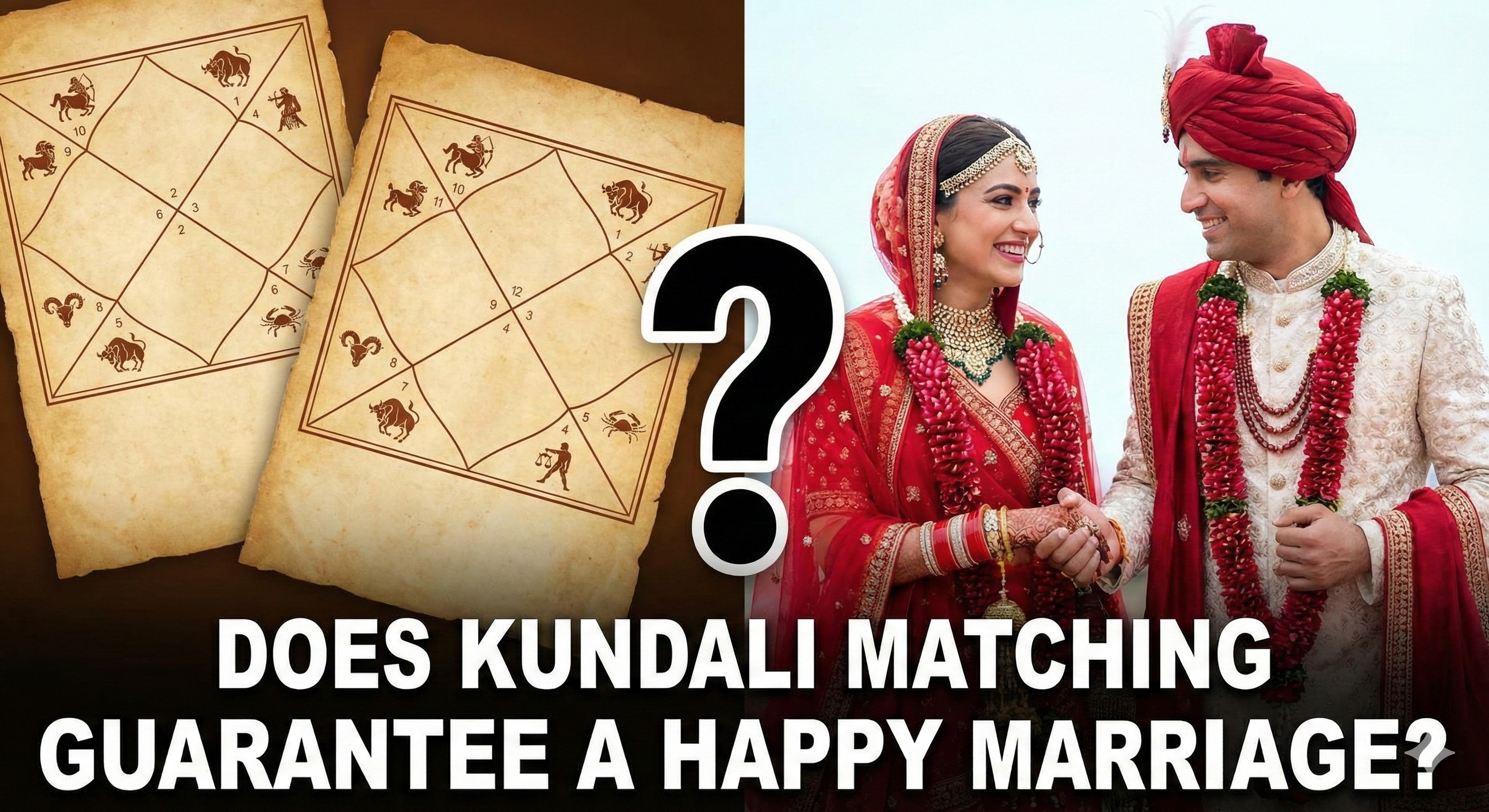
This is the "Million Dollar Question" that every parent and every couple asks themselves.You have a score of 29 / 36, the Pandit has given his blessing, and the horoscopes are favorable.Does this mean your marriage is now immune to divorce, infidelity, or misery ? The honest answer from the depths of Vedic philosophy might surprise you.Kundali matching is a bridge, but you are the ones who must walk across it.This comprehensive conclusion to our series explores the intersection of fate, character, and the human will in the success of a marriage.
💕 Curious about your personal connection?
While Kundali matching offers a comprehensive view, you can check your instant emotional compatibility using our Vedic Love Calculator.
Try Free Love Calculator →💕 Curious about your personal connection?
While Kundali matching offers a comprehensive view, you can check your instant emotional compatibility using our Vedic Love Calculator.
Try Free Love Calculator →The Statistical Truth: Probability vs.Certainty
Think of Kundali matching as aWeather Forecast . If the forecast says it will be sunny (High Guna score), you can plan an outdoor wedding with 90% confidence. But a sudden, unpredictable storm can still happen. Conversely, if the forecast says rain (Low Guna score), you can still have a great wedding if you bring umbrellas and stay indoors.
High compatibility points mean that the natural friction between your personalities is low. It doesn't mean problems won't come from the outside (career loss, health issues, third - party interference). It only means that when those problems come, you two are less likely to turn against each other.
The Context Matters: Which "Type" of Marriage is it ?
Vedic texts(Manusmriti) define 8 types of marriage.Kundali matching works differently for each.Understanding which category you fall into can explain why a "High Score" might fail or a "Low Score" might work.
1. Brahma Vivah(The Ideal Arranged Marriage)
This is when families arrange the match based on shared values and respect.Kundali matching is 100 % effective here because the couple is following the social script. The high score supports the family harmony.
2. Daiva Vivah(The Service Marriage)
When a girl is married to a priest or official as an act of sacrifice / charity. (Rare today).Matching is less relevant as duty drives the bond.
3. Arsha Vivah(The Sage Marriage)
Marriage to a sage.The dynamic is Guru - Shishya(Teacher - Student).If the 7th house shows Jupiter influence, this works even with a low score.
4. Prajapatya Vivah(The Civil Partnership)
The couple marries primarily to have children and fulfill societal duties.It is practical.A high Nadi score(health) is crucial here.
5. Gandharva Vivah(The Modern Love Marriage)
This is based on mutual attraction / lust. Kundali matching is LEAST effective here initially. Why? Because the couple is running on Venus energy (passion), not Moon energy (domestic comfort). However, once the passion fades (after 2-3 years), the Guna score kicks in. This is why many love marriages fail after the "Honeymoon Phase"—the biological attraction masked the astrological incompatibility.
6. Asura Vivah(The Transactional Marriage)
Where money is exchanged(Dowry / Bride Price).This is a business deal.The planetary periods(Dashas) of wealth matter more here than emotional compatibility.
7. Rakshasa Vivah(The Abductive Marriage)
Forcible marriage.Obviously, astrology does not apply to crimes.
8. Paishacha Vivah(The Deceptive Marriage)
Marrying someone while they are unconscious, intoxicated, or deceived.This results in terrible karma.
The Three Pillars of Success Beyond Points
Guna Milan(The 36 points) is only ONE pillar.To guarantee success, you need to look at three other astrological factors that are often ignored:
1. Character(Sheela) - The Lagna Pillar
A man might have 36 / 36 points with a woman, but if his 1st house is under the influence of Rahu and a debilitated Saturn, he might have an abusive nature.Compatibility assumes two healthy individuals.No amount of compatibility points can save a marriage where the individual character is broken.Astrology calls this "Lagna Shuddhi" —the purity of the self.
2. Longevity(Ayurdaya) - The 8th House Pillar
This is a dark but vital part of matching.If the compatibility is high but one partner has a "Alpa-ayu Yoga"(Short Life), the marriage will obviously not be "happily ever after." Traditional astrologers check this first before even looking at the points.Health is wealth.
3. The Dasha(Timing) - The Time Pillar
A couple with 30 points who enter their marriage during their most difficult planetary periods(e.g., both running Sade Sati or Rahu - Ketu axis) will face immediate stress.They might survive it because of their compatibility, but it won't feel "easy." Real success requires favorable timing.
| Marriage Pillar | Astrological Section | The Human Equivalent |
|---|---|---|
| Compatibility | Guna Milan(36 pts) | Shared interests and temperament. |
| Success / Wealth | 7th & 11th House Lord | Career stability and financial growth. |
| Character | 1st House(Lagna) | Individual maturity and kindness. |
The 30 % Rule: The Power of Free Will
Vedic astrology is not deterministic.It operates on the principle of Prarabdha Karma (Destiny/Fixed - 70 %) and Agami Karma (Free Will/Future Choices - 30 %).
This means that 30 % of your marriage success depends on your current daily choices . If you choose to lie, if you choose to be lazy, or if you choose to prioritize your ego over your partner, the 36 points will not save you. Conversely, if you choose to be patient and forgiving, you can make a 14-point match work beautifully.
Case Study: The 35.5 Point Disaster
A famous royal case involved a couple with 35.5 out of 36 points.They were "Perfect." Yet, the marriage ended in 2 years.Why ? Because their individual charts showed high arrogance(Sun in 1st house for both).They were "too similar." They both wanted to lead, and neither wanted to follow.This is why Individual Chart Strength is more important than the Match Score.
The Role of In - Laws: The Hidden Fourth Chart
In Indian marriages, you don't just marry a person; you marry a family. A Kundali match might show harmony between Boy and Girl. But what about Girl and Mother-in-Law?
The Rule: The 4th House represents the Mother-in-Law. If the Bride's Moon is in the 6th/8th house from the Groom's Mother's Moon, domestic wars are inevitable, even if the husband is a saint.Advanced matching always checks the "Saas-Bahu" compatibility.
Final Checklist for Couples
Before saying "I Do" based on a report:
1. Check the Nadi and Bhakoot(Foundation).
2. Check the Individual Character(Are they a good person ?).
3. Check the Timing(Is this a good year to marry ?).
4. Commit to using Free Will (Agami Karma) to solve problems.
Conclusion: A Tool for Empowerment, Not a Shield
Does Kundali matching guarantee a happy marriage ? No.
Does it significantly increase the PROBABILITY of a happy marriage ? Yes.
The stars show the path, but you are the driver.Use Jodi - Sarthi to understand your map, then drive with wisdom, love, and commitment.
Empower your relationship. Get a holistic view of your future today.
Appendix Vol 2: Advanced Vedic Concepts for the Curious
For those who want to go beyond the basics, here are four advanced factors that expert astrologers check before giving a "High Compatibility" verdict.These concepts explain why some 18 / 36 matches thrive while some 30 / 36 matches struggle.
1. The Navamsha(D - 9) Chart: The Fruit of the Tree
The main Birth Chart(Rasi or D - 1) is like the tree itself.It shows what you are born with.But the Navamsha(D - 9) chart is the fruit.It shows what you will become after marriage.
The Rule: If a planet is weak in the main chart (e.g., Debilitated Venus) but strong in the D-9 chart (Exalted Venus), the marriage will improve over time. We call this "Neecha Bhanga." Conversely, if compatibility looks great in the main chart but the D-9 charts of the couple are hostile, the marriage will start well but rot from the inside.
2. The Role of the Atmakaraka(Soul Planet)
In Jaimini Astrology, the planet with the highest degree in your chart is your "Atmakaraka," representing your soul's desire.
Matching Secret: If the Groom's Atmakaraka is the same as (or friends with) the Bride's Atmakaraka, their souls are on the same mission. They might fight about money or dishes, but they will never fight about purpose.This is often the secret ingredient in "Soulmate" connections.
3. Dasha Sandhi: The Danger Zone
Timing is everything. "Dasha Sandhi" refers to the period when a major planetary cycle(Mahadasha) ends and a new one begins.
The Risk: If both partners are going through Dasha Sandhi at the same time (within 6 months of the wedding), it is a major red flag. The energy is too unstable. Most astrologers will advise waiting for the new Dasha to settle before tying the knot. Ignoring this often leads to sudden, inexplicable separations in the first year.
4. Gotra Compatibility: The Original Genetic Testing
You might hear elders say, "We cannot marry within the same Gotra." This is not just superstition; it was ancient genetic science.
The Logic: Gotra traces the patrilineal DNA (Y-chromosome). Marrying within the same Gotra increases the risk of recessive genetic disorders resurfacing. Modern science calls this "consanguinity." By enforcing Gotra exogamy, the Rishis ensured a diverse and healthy gene pool thousands of years before DNA was discovered.
5. Shadbala: The Six - Fold Strength
Points are just quantity.Shadbala is quality.
Example: You might have "Mars" matching "Mars" (Kuja Dosha cancellation). But if the Boy's Mars has a Shadbala score of 150% (Very Strong) and the Girl's Mars has 80% (Weak), the cancellation fails. The strong Mars will overpower the weak one. Deep matching always compares the Ishta Phala (Good Strength) vs Kashta Phala (Bad Strength) of the planets involved.